
Today we embark on the next Chapter: Michigan. As I write, we are underway to today’s destination, Drummond Island. While technically still the North Channel, Drummond is the first American island in the North Channel, with Mackinaw and Lake Michigan to the west. Here we will check into a marina to clear customs. Clearing customs when crossing the border by boat is a little different than doing so on land or at airports. The easiest is using the Nexus pass – you simply make a phone call to US Customs & Border Security when you are about 1 hour away from port, answer a few questions about your boat and destination plus the standard stuff about what you are declaring, get a confirmation number and you’re done….if they want to inspect your vessel, they will be waiting for you at the dock. In summers past we’ve crossed Lake Ontario several times and checked into both USA and Canada using this process – easy peasy. However, Allen’s Nexus expired a few days ago on his birthday, and despite his renewing it online before we left, the new card has not arrived due (backlogged due to the partial US government shut-down), so we have to use the alternative method – the ROAM program.
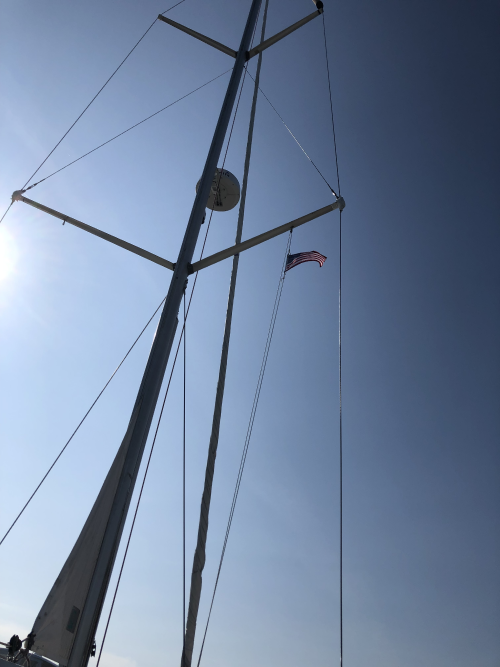
ROAM is a new program for crossing the border by boat. You simply use the app to enter your boat and passenger info, answer 3 questions (do you have commercial material, do you have $10K+ in cash, do you have food) and wait for someone to process it. If they have any questions, you get a video chat with an officer. Since we are arriving in our home, we answer no to the first two, and yes to the food question. Today the process took about a half hour, no hassles and we’re in! Now we can raise our US flag on the starboard flag halyard, as per flag etiquette. Flag etiquette is taken very seriously and can be rather complicated and differs for sail and power boats. Basically, as a Canadian sailboat, we fly our Canadian flag on the stern at all times and when visiting a foreign country, we fly its flag in a place of honor, at the second spreader, starboard side.
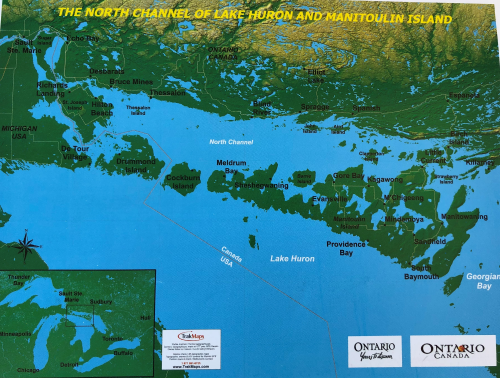
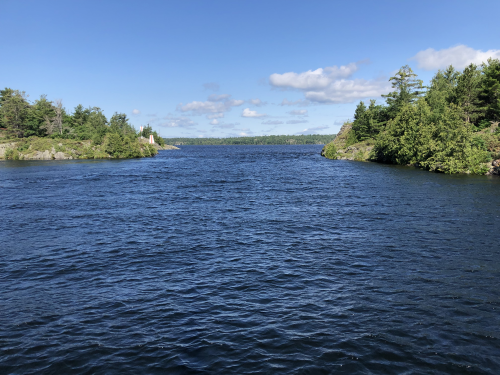
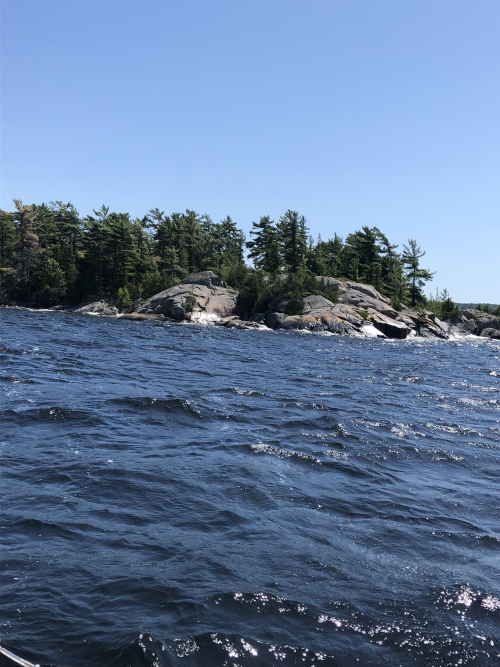
Our last week in the North Channel was much the same as the others – beautiful and peaceful. We returned to the Benjamin Islands for one more night, picked more wild blueberries, but found the spot a bit too crowded. It’s a popular destination and I counted 18 boats in our bay. Next was Hothom Island, with a very protected bay to ride out some thunderstorms and celebrate Allen’s birthday, then Beardrop Bay, with uncomfortably high winds, gusts up to 25 knots, that would make a less seasoned sailor a bit green. Then a night anchored in Gore Bay, a town with all the essential services (groceries, hardware store, and restaurants) and a special treat – community theatre. We enjoyed the closing night production of “This is How We Got Here” by Keith Barker, an award-winning play. Last night we had a quiet anchorage in Vidal Bay.
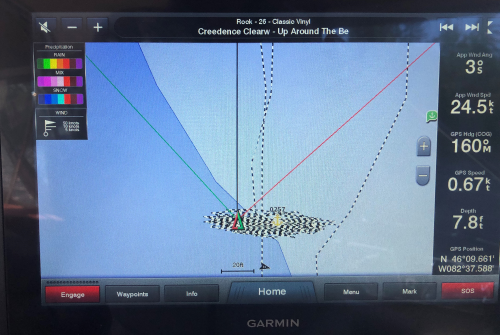
An image of the chart plotter showing Meshuggana swing at anchor for 6 hours of 25 knot winds.
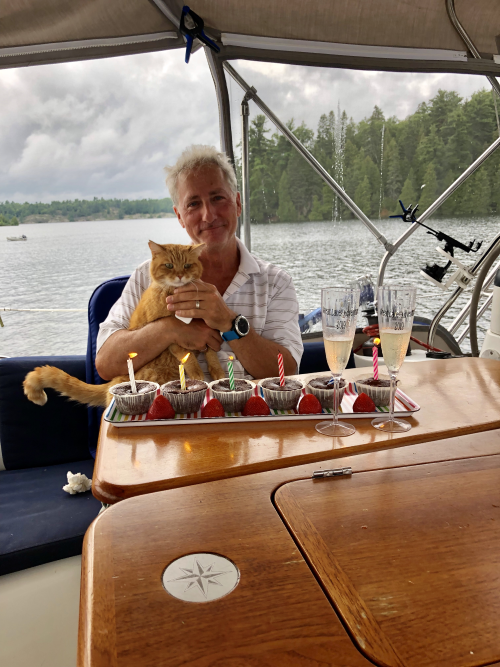
Birthday Boys! Allen’s on July 29 & Cat Stevens’ on July 21
Today also marks the 10th week of our Great Lakes Adventure (11th of living on the boat) and in less than two weeks we will turn around and begin our journey home. Sometimes it’s hard to believe that it’s been almost 3 months since I moved out of my house and into 400 sq feet with no set address. I’ve almost forgotten my life on land, but admit there are times I long for it. However, as I’ve said before, we really aren’t roughing it. These are some of my observations from the last 10 weeks:
- Electricity. Most of the time we live off the grid and harness the sun’s power with 5 solar panels that can generate up 800 watts. The power is stored in 6 batteries, 4 for the house, 1 for the engine and 1 for the bow thruster. On a sunny day the batteries are fully charged well before noon and we are spilling energy the rest of the day. If we were to have a string of cloudy days, we could run our engine to charge the batteries, or the generator, though this has not been necessary as we have been incredibly blessed with good weather. So, where do we use electricity?
- Refrigerator and deep freezer – our biggest electrical draw. While not as big as my fridge in the house, we easily have enough room for about 2 weeks of food, and we can make ice too!
- Navigational instruments – GPS, radar, sonar, auto-helm. Without these we’d be in big trouble.
- Lighting – as the days are still long, we don’t use much artificial lighting, but we do have plenty of LED ceiling lights throughout the boat. At dusk we turn on our anchor light, a light at the very top of our mast, to indicate our presence and the fact that we are anchored, to any other vessel that may enter the area after dark. Not only is it important for safety, it’s also the law.
- The heads and water pumps – we have 2 washrooms with electric flush toilets as well as hot & cold running water in 3 sinks (one per washroom and one in the galley). The water is heated by the engie when motoring and the tank holds enough water for a couple brief showers and washing dishes for about 2 days.
- Phone chargers, fans, microwave, TV, the Dyson, electric toothbrush etc – thanks to the solar panels, we have enough power for all of these conveniences
- About once every 7-10 days we dock at a marina, mainly to buy provisions, do laundry and get wifi, but we also plug into their electricity. When “plugged-in”, we can also run our air-conditioning (or heat) – we have 2 AC units, one for the main salon and another for our bedroom.
- Internet/data – it’s REALLY easy to chew it up and it’s really expensive! Canada is one of the most expensive countries in the world when it comes to cell/data plans. We’re always on the lookout for free wifi. We love to linger in coffee shops, restaurants or even the public library.
- Water – we have to be careful with fresh water consumption. While in the Great Lakes this is not a huge problem as we can pull into any marina and fill-up with no hassle and no cost. However, in off-shore and saltwater environments, fresh water is not always available and it is not free. Most boaters invest in a water maker when sailing in saltwater. One thing I miss about living on land is taking long, luxurious showers with seemingly unlimited hot water. While we can shower on the boat, we use just enough water to suds-up and rinse-off.
- Laundry/Clothing – if it’s dry and doesn’t stink too bad, it’s fair game. Laundry is a luxury. Enough said.
- Food – as I mentioned above, we have great capacity in our fridge, as well as other dry storage. We do not go hungry; however, our biggest challenge has been fresh produce. Only a few of these northern towns have grocery stores, and those stores are often picked over and very expensive. The problem is they are at the very end of the delivery route and by the time the trucks leave the Toronto food terminals and make their journey north, stopping along the way at every other small town, only the dregs are left, plus a hefty transportation cost. I was hoping to buy our produce at farmer’s markets, but so far they have been disappointing, with very little or no produce and bigger focus on items like jams, honey and crafts.
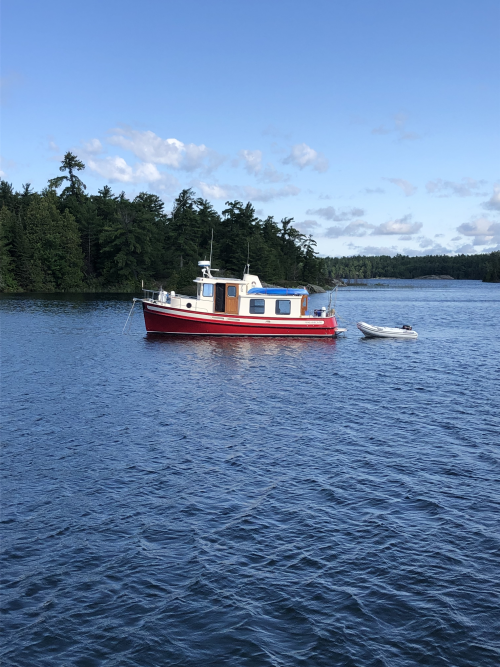
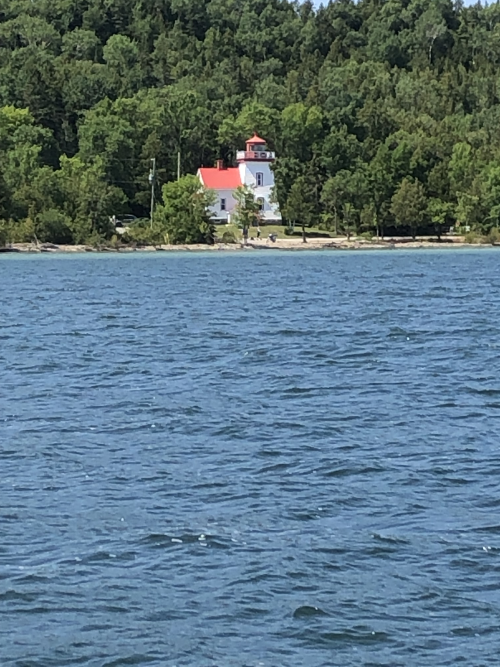
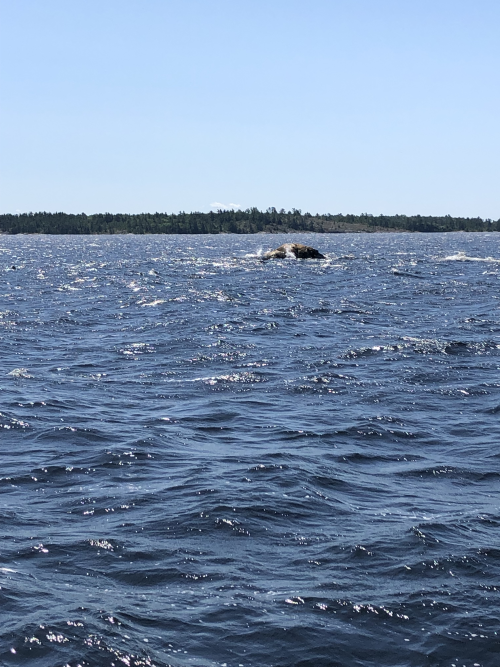
So, this wraps up the North Channel – onward to Lake Michigan!
Sounds like everything is going well- 11 weeks on board is a great experience- enjoy Lake Michigan
Happy bday kitty and Allen!